Beyond the Benchmark: How OEM-Validated AI and HPC Fabrics Reduce Deployment Risk
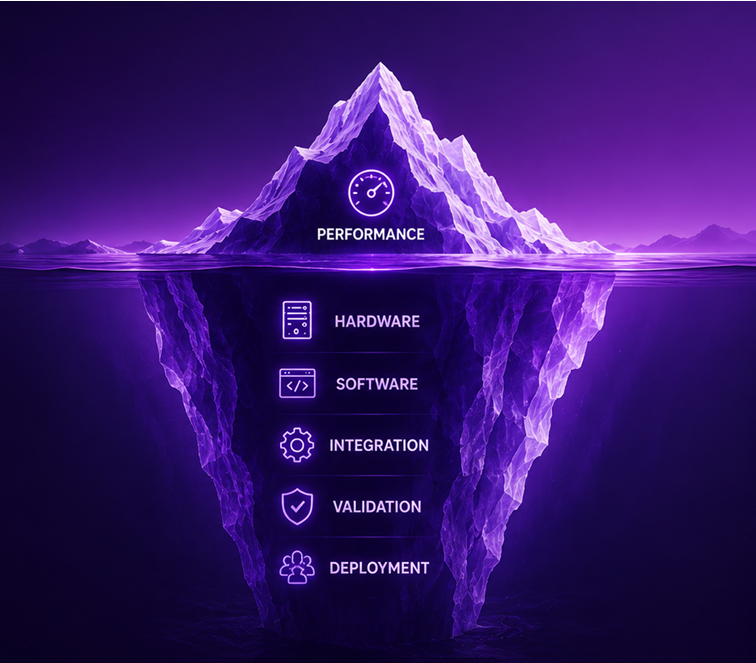
Key takeaways:
OEM validation improves customer experience by finding integration issues before deployment, reducing troubleshooting and leaving more system time for research and engineering.
Validated platforms and reference architectures accelerate time to production by giving customers a proven starting point instead of qualifying every combination from scratch.
Working with OEM partners, Cornelis® has validated nearly one server every week over the past year.
Why validated designs matter
A few weeks ago, I upgraded part of my backyard by replacing dirt with pavers. Before buying anything, I looked through the manufacturer's design guide. In addition to different paver sizes and styles, the guide showed retaining walls, topper stones, and layouts that had already been proven to work. I then worked with my chosen landscape crew to adapt one such layout to my yard.
I still had decisions to make, but I was not starting from scratch. Validated designs do not eliminate the work. They reduce uncertainty.
The same principle applies to AI and HPC infrastructure. Every week spent resolving integration problems is time a cluster is not doing the work it was purchased to do. For customers, reducing that uncertainty means a faster path from installation to useful work.
The benchmark is only part of the story
When a new AI/HPC platform is introduced, performance numbers naturally get attention. Bandwidth, latency, message rate, scaling, and application performance all matter. But a benchmark is the visible outcome of a much larger engineering effort.
A production cluster combines servers, processors, accelerators, NICs, switches, cables, BIOS, firmware, operating systems, drivers, management software, storage, and applications. Each layer may work correctly on its own and still expose unexpected behavior when integrated with the others.
That is where deployment risk often hides: at the interfaces. A BIOS setting can affect PCIe behavior. A firmware dependency can appear during a particular initialization sequence. A management interface may behave differently across server implementations. Full-system validation is designed to find these issues before they become customer problems.
One example comes to mind, from a recent qualification with a Tier 1 server OEM. During system management testing, we found an unexpected interaction. The server's baseboard management controller and the CN5000 Omni-Path® SuperNIC firmware did not exchange Platform Level Data Model management data correctly. Both components worked independently, but the issue only surfaced when they were integrated on the platform. Jointly, the OEM and Cornelis engineering teams isolated the issue and addressed it in firmware during qualification.
What OEM validation really covers
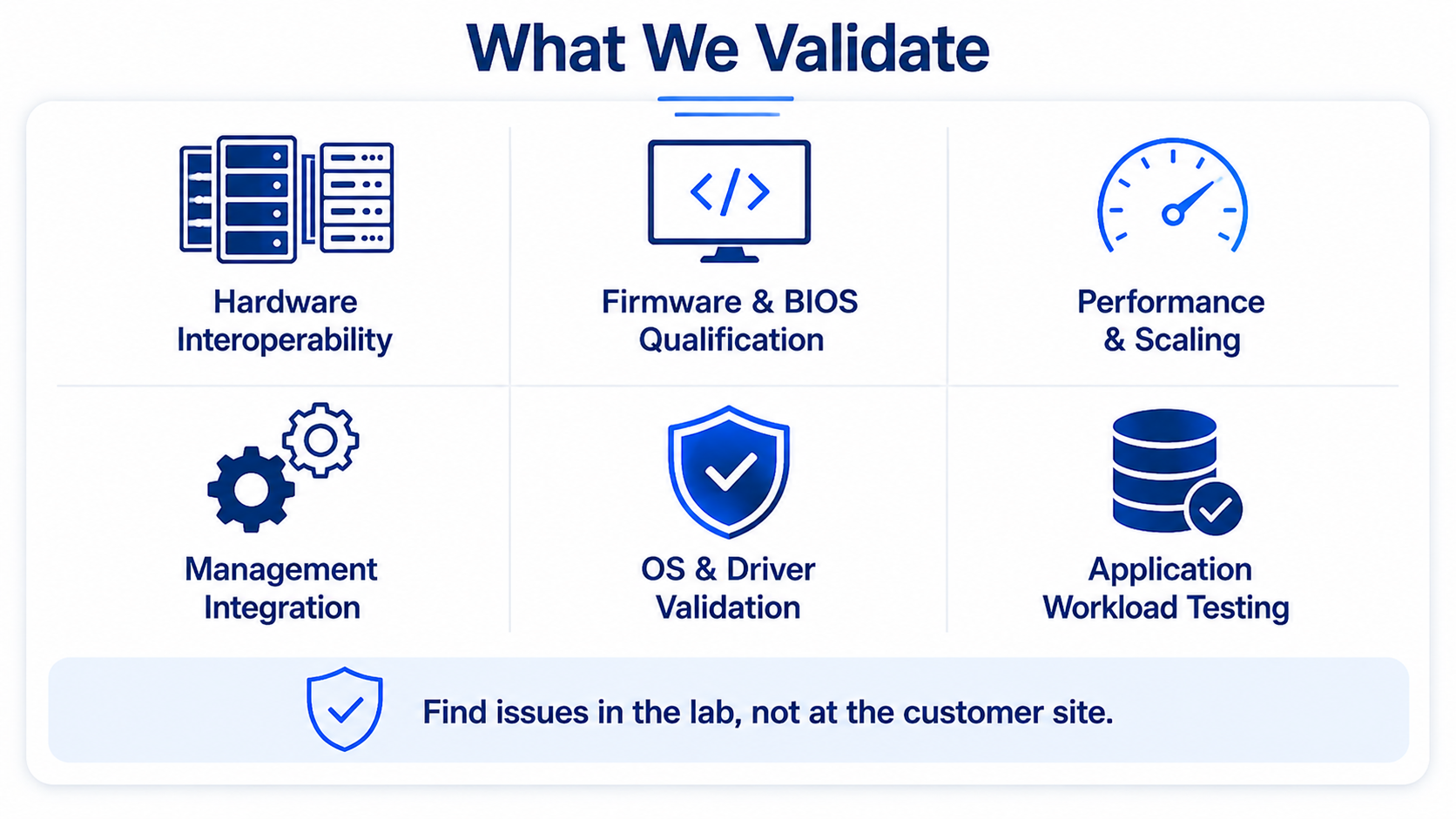
OEM qualification goes far beyond confirming that a NIC is detected, a fabric comes up, or a performance test passes. Joint engineering teams exercise the complete platform and look for issues that can affect performance, reliability, manageability, or deployment.
Hardware compatibility: Servers, NICs, switches, cables, PCIe behavior, and supported configurations
Firmware and BIOS qualification: Versions, settings, initialization behavior, and platform compatibility
Performance and scaling: Application behavior across relevant traffic patterns and system scale
Management integration: Platform management, health reporting, monitoring, and telemetry
OS and driver validation: OS, drivers, fabric software, and supported software combinations
Application workload testing: AI and HPC workloads, stress testing, and system-level scenarios
OEM validation as a cornerstone of the Cornelis ecosystem
At Cornelis, OEM validation is a core part of how we bring our fabrics to market.
Our 400 Gb/s CN5000 fabric is integrated across a broad ecosystem. In the last year alone, we worked with more than 10 OEM partners and qualified more than 50 server configurations. These span major global OEMs and specialized AI and HPC system providers. And the ecosystem continues to grow.
That breadth matters because customers rarely choose a network in isolation. They may already have a preferred server vendor, processor architecture, form factor, cooling strategy, or system design. A broad set of validated platforms gives customers more freedom. They can build around those requirements rather than forcing the rest of the infrastructure around the fabric.
The collaboration also creates a useful feedback loop. Cornelis engineers learn how the fabric behaves across different system architectures, while OEM teams build deeper experience integrating CN5000 products into their platforms. Issues can be identified earlier, best practices can be documented, and those lessons can carry forward into future platforms.
Several of these collaborations with our partners have resulted in published solution briefs, performance validation, best practices, reference architectures, rack-scale designs, and application scaling studies. These publications represent the visible outcome of that engineering collaboration. They give customers a documented starting point, based on systems that engineering teams have already integrated and validated.
What to consider when evaluating a fabric
Performance is table stakes. But a benchmark alone does not tell you how deployment-ready a solution is. Buyers should also ask:
Has the fabric been jointly validated with the OEM platform I plan to deploy?
Which server, firmware, BIOS, OS, driver, and fabric software combinations were qualified together?
Does validation include management integration and operational behavior?
Are application results, solution briefs, or reference architectures available?
How is the solution maintained as platforms, firmware, operating systems, and processors evolve?
Start with a proven foundation
Validated platforms and reference architectures provide a better starting point, reduce qualification uncertainty, and give customers more confidence as a deployment moves from the lab into production. If you are planning an AI/HPC deployment, explore the published Cornelis solution briefs and reference architectures with OEM partners. Then ask your technology partners not only how their solution performs, but how thoroughly the complete platform has been validated.
The best engineering is often invisible.
When a cluster installs smoothly, reaches expected performance, integrates cleanly with management tools, and runs reliably, the deployment can look straightforward. Behind that result are engineering teams working across hardware, firmware, software, validation, and system integration. Customers may never see that work.
That is exactly the point.
Ready to explore?
Planning your next AI or HPC deployment? Explore Cornelis' validated OEM solutions and reference architectures or contact us to discuss your platform requirements.
OEM partners interested in joint platform validation can also connect with the Cornelis team at sales@cornelis.com.