Scale AI and HPC on Your Choice of Fabric With CN6000 800G Omni-Path and Ethernet SuperNICs
Bhanu Vemula, Head of Product Management
Key takeaways
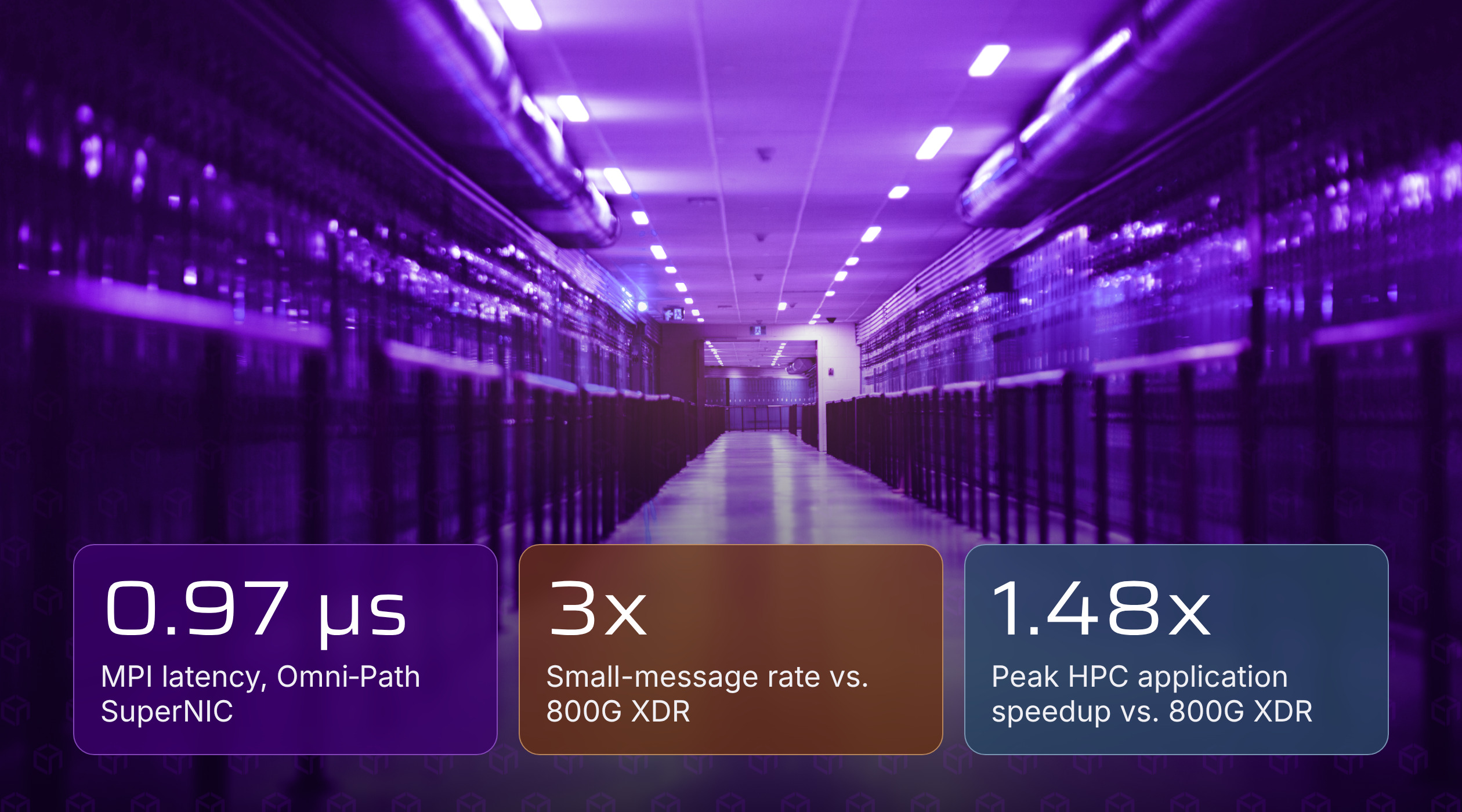
Performance ready for scale: In Cornelis testing, the CN6000 Omni-Path SuperNIC measured 0.97 µs MPI latency and up to 3 times the small-message rate of 800G XDR InfiniBand, with post-quantum crypto (PQC) root of trust on every card.
More choice through open standards: The new CN6000 Ethernet SuperNIC brings RoCEv2 to standards-based Ethernet switches and supports Ultra Ethernet through early access, a first notable step toward open, standards-based Ethernet fabrics.
A roadmap you can plan on: CN6000, the second generation of Cornelis SuperNICs, is shipping now. CN5000 investments carry forward to CN7000.
How CN6000 compares with 800G XDR InfiniBand on latency and message rate
Accelerators are the largest line item in an AI or HPC cluster. Every microsecond a GPU waits on the network adds to time to results and cost. CN6000 is built to cut that wait. It doubles bandwidth to 800 Gb/s and message rate to up to 1.6 billion messages per second on a PCIe 6.0 bus, while adding a standards-based Ethernet SuperNIC to the family.
Scale starts with performance per node. Cornelis engineers measured the CN6000 Omni-Path SuperNIC against an 800 Gb/s XDR InfiniBand configuration in point-to-point tests. The gap was widest on the small messages that HPC codes and AI collectives send most often. CN6000 answered sooner at the smallest message size, and it kept far more messages moving as the number of processes on each node grew.
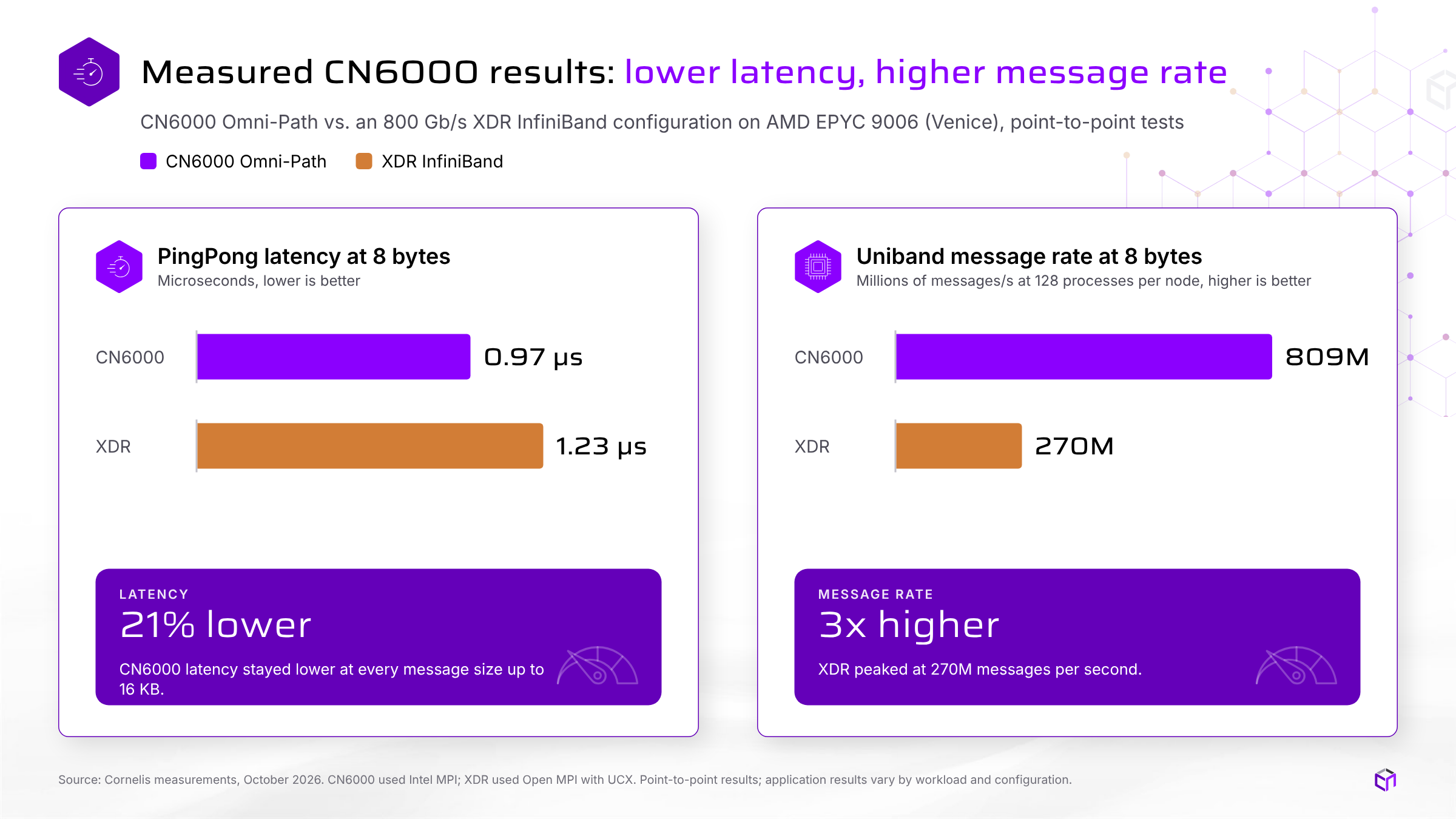
Figure 1. Measured CN6000 Omni-Path results versus an 800G XDR configuration. CN6000 used Intel MPI; XDR used Open MPI with UCX.
In these tests, CN6000 measured 0.97 µs of latency compared with 1.23 µs for XDR, about 21% lower. At 128 processes per node, CN6000 reached 809 million messages per second, about three times the XDR result. Lower latency and higher message rate help communication-bound HPC codes and AI collectives finish sooner, although results vary by workload and configuration.
CN6000 builds multi-plane networking into the silicon
Large AI and HPC clusters increasingly use multi-plane networks: two or more separate fabrics that every node connects to. Teams build them to keep collectives on one plane and checkpoints or storage on another. They also keep a failure in one plane from stopping the whole cluster. CN6000 supports this design from the silicon up. Each SuperNIC drives two independent 400 Gb/s data paths. The CN6000 Omni-Path Switch is natively designed for multi-plane with two independent 48-port 400G planes, and one cable per node reaches both. Open-source OPX software can then use both planes at once for up to 800 Gb/s per node, so teams get the resilience of two fabrics with one SuperNIC and one cable per node.
That separation starts in the silicon and runs all the way to the switch. Because the server sees each 400G pipeline as its own device, the host can treat the two planes as two independent networks. A single cable then carries both links to the CN6000 Omni-Path Switch, where each plane lands on its own switch ASIC with 48 ports of 400G. A problem on one path stays on that path, and the other keeps working.
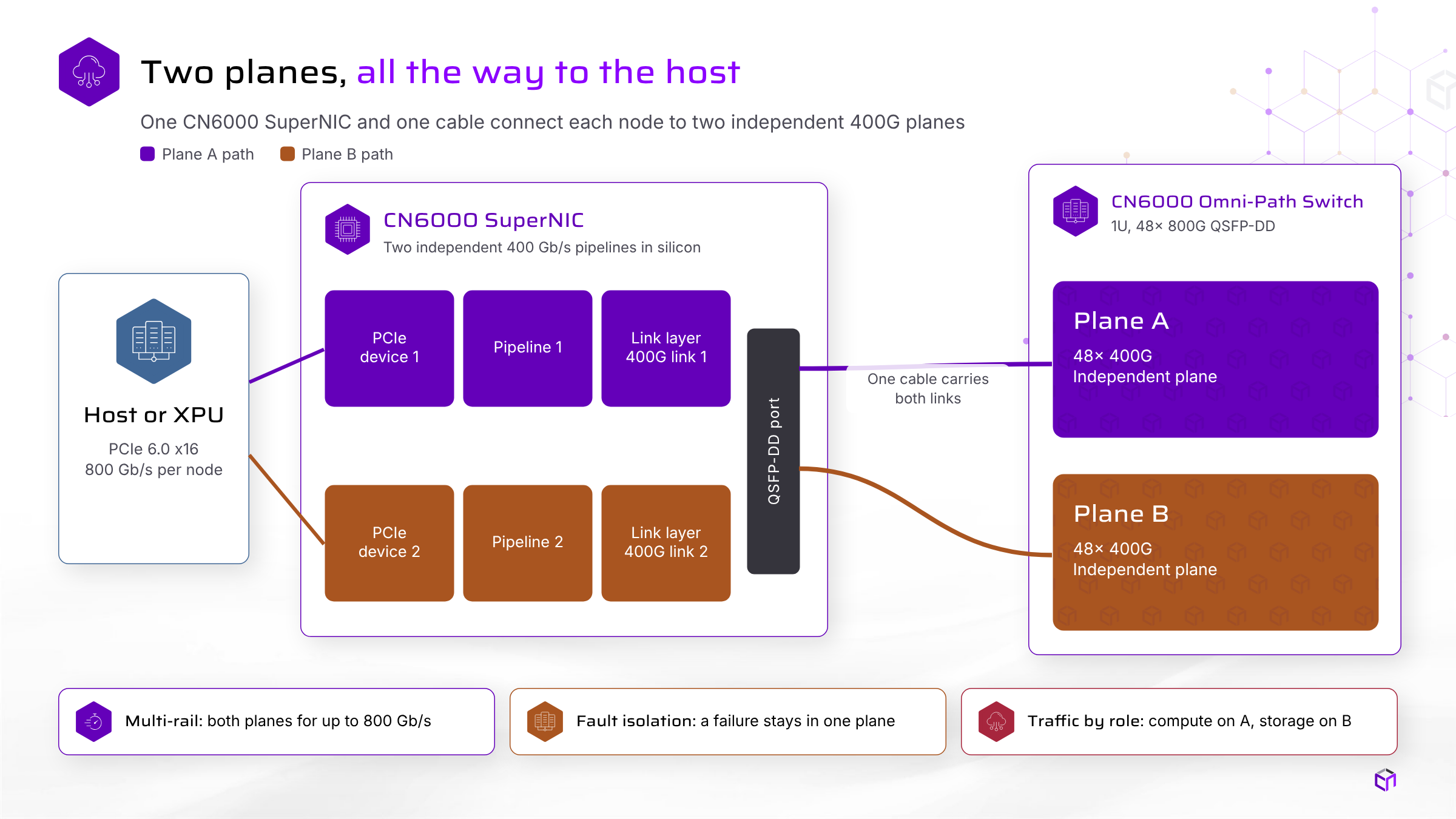
Figure 2. CN6000 keeps two 400G planes separate from the switch ASIC, through one cable and the SuperNIC, up to the host.
For operators, the design pays off in four ways:
Up to 800 Gb/s per node: Multi-rail software drives both planes at once, while each plane keeps the radix and low hop count of a 400G fabric.
Faults stay contained: A switch, link, or optics failure in one plane leaves the other running, so long jobs keep going while the part is serviced.
Traffic stays separate: Compute and collectives can run on one plane while storage and checkpoint traffic run on the other, so they stop competing for the same paths.
Multi-plane by design: One 1U CN6000 Omni-Path Switch holds two independent 48-port 400G planes, for 48 ports of 800G or 96 ports of 400G. Each plane keeps the radix and low hop count of a 400G fabric, and conduction cooling supports high-density racks.
These fabrics are also built to grow. Omni-Path fabrics built with CN6000 are designed to scale beyond 500,000 endpoints, and the same Omni-Path architecture already runs the 952-node Lynx cluster at Lawrence Livermore National Laboratory and more than 600 nodes of Stampede3 at TACC with CN5000.
Quantum-safe trust, built into every card
As clusters grow, so does the number of devices that must be trusted. Every CN6000 SuperNIC includes a dedicated hardware root of trust, separate from the SuperNIC chip. Through SPDM 1.4 attestation, the server and its baseboard management controller (BMC) can confirm that the card is the genuine one that was shipped and installed, which helps block supply chain attacks. The root of trust also checks the signed firmware image every time the card boots, so tampered firmware does not run.
Those signatures use ML-DSA-87, the top-tier post-quantum algorithm in NIST FIPS 204, alongside classical ECDSA P-384. Governments are starting to require this protection: the NSA CNSA 2.0 suite names ML-DSA-87 for signatures on US national security systems and calls for firmware signing to move fully to post-quantum algorithms by 2030. Support is still uneven across AI and HPC network cards. Public datasheets for several current models list secure boot and attestation without post-quantum signatures. Some vendors offer it only on selected models. CN6000 builds it into every SuperNIC, with SPDM 1.4 attestation, so federal and defense buyers can meet the requirements now.
Ready to deploy through partners
CN6000 is shipping now from Cornelis. Server OEMs and system partners will deliver it in configured AI and HPC systems beginning in Q1 2027, and a published reference architecture pairs CN6000 with AMD EPYC “Venice” processors and AMD Instinct MI400 series accelerators.
Cornelis is moving toward open, standards-based Ethernet fabrics, and CN6000 is the first notable step on that path. For the first time, the family includes an Ethernet SuperNIC beside the Omni-Path SuperNIC. Customers choose the SuperNIC that fits each cluster.
Both SuperNICs share the same 800G heritage, so the choice comes down to the fabric each cluster runs. Teams that need the lowest latency and highest message rate for HPC and performance-intensive AI can choose the Omni-Path SuperNIC. Teams that standardize on Ethernet can choose the Ethernet SuperNIC and keep the switches they already run.
CN6000 SuperNICs are available in a low-profile PCIe card (MD2) and an OCP 3.0 module, so OEMs and integrators can design them into standard rack servers and dense AI platforms alike. Air-cooled and conduction-cooled versions let the same SuperNIC fit conventional air-cooled racks as well as sealed, conduction-cooled chassis, which helps operators add CN6000 without redesigning their data center around the network.
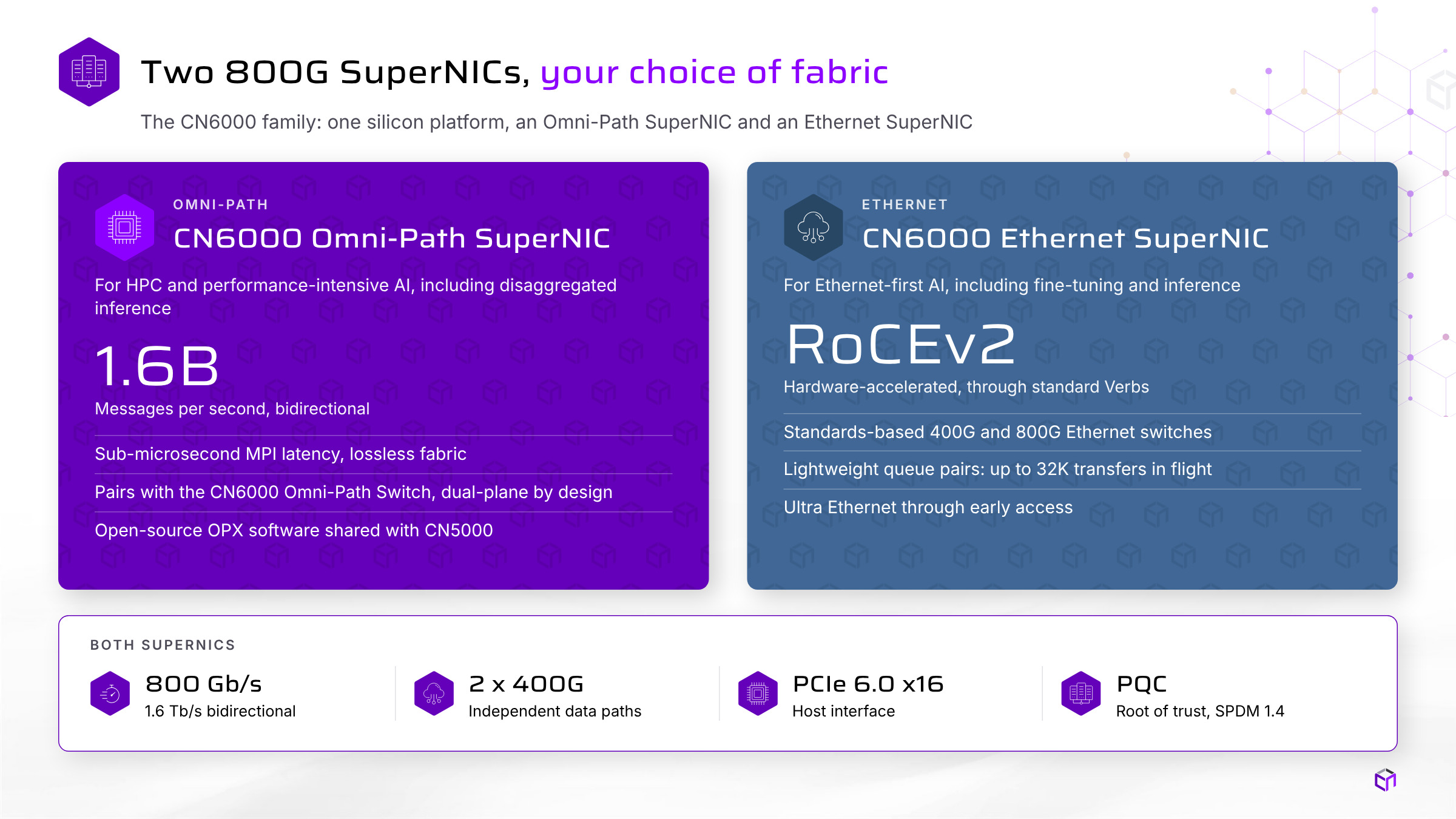
Figure 3. Two 800G SuperNICs, your choice of fabric.
The Ethernet SuperNIC runs hardware-accelerated RoCEv2 on the standards-based 400G and 800G switches that AI teams already run. It is built for fine-tuning and inference on Ethernet networks, and it supports Ultra Ethernet through early access, which reflects our commitment to open standards. That openness extends to software, since Omni-Path runs on libfabric, the open interface that Cornelis originally developed.
Partners see the same direction. In the CN6000 announcement, Jeff McVeigh, Vice President and GM of Data Center Strategic Programs at Intel, said: “CN6000 brings an 800G fabric to Xeon 6 platforms over PCIe Gen6 and supports Ethernet and Omni-Path. It fits the open, standards-based infrastructure Intel is building and will give our customers performance and deployment flexibility.”
CN5000 today, CN6000 next, on one fabric
CN6000 does not replace the need to build now. Many teams have capacity to deploy this year, and CN5000 is the shipping, production-proven Omni-Path choice for that work. Because both generations share one fabric and one software stack, a CN5000 cluster can add CN6000 nodes later without a new protocol or new application code. Use this guide to match each generation to the job:
CN5000 for 400G Omni-Path clusters deploying now: It is shipping, in production at national labs, and a strong fit for PCIe 5.0 and PCIe 6.0 server platforms.
CN6000 Omni-Path SuperNIC for 800G nodes: It pairs with PCIe 6.0 platforms and the dual-plane CN6000 Omni-Path Switch, and it can join an existing CN5000 fabric.
CN6000 Ethernet SuperNIC for Ethernet-first AI: It brings low-latency RoCEv2 to standards-based switches for fine-tuning and inference.
Cornelis delivers on roadmap from CN5000 through CN6000 to CN7000
AI and HPC infrastructure is a multi-year bet, so buyers need a fabric roadmap they can count on. When Cornelis introduced CN6000 in November 2025, it set a plan for customer sampling in mid-2026, with production deployments to follow. That plan is on track. The Cornelis CN6000 family, including SuperNICs, switches, and software, is available from Cornelis today for evaluation and early deployments, with systems from OEM and system partners beginning in Q1 2027.
The roadmap also protects what customers already run. CN5000 and CN6000 SuperNICs share the same open-source OPX software and host driver, so they can operate in one Omni-Path fabric, and applications carry forward to CN7000 with a fully compatible host software stack.
Each generation builds on the one before it. CN5000 and CN6000 are both shipping now, and CN7000 extends the roadmap to Active Compute Fabric and in-network compute. An investment in CN5000 today keeps paying off as the fabric grows.
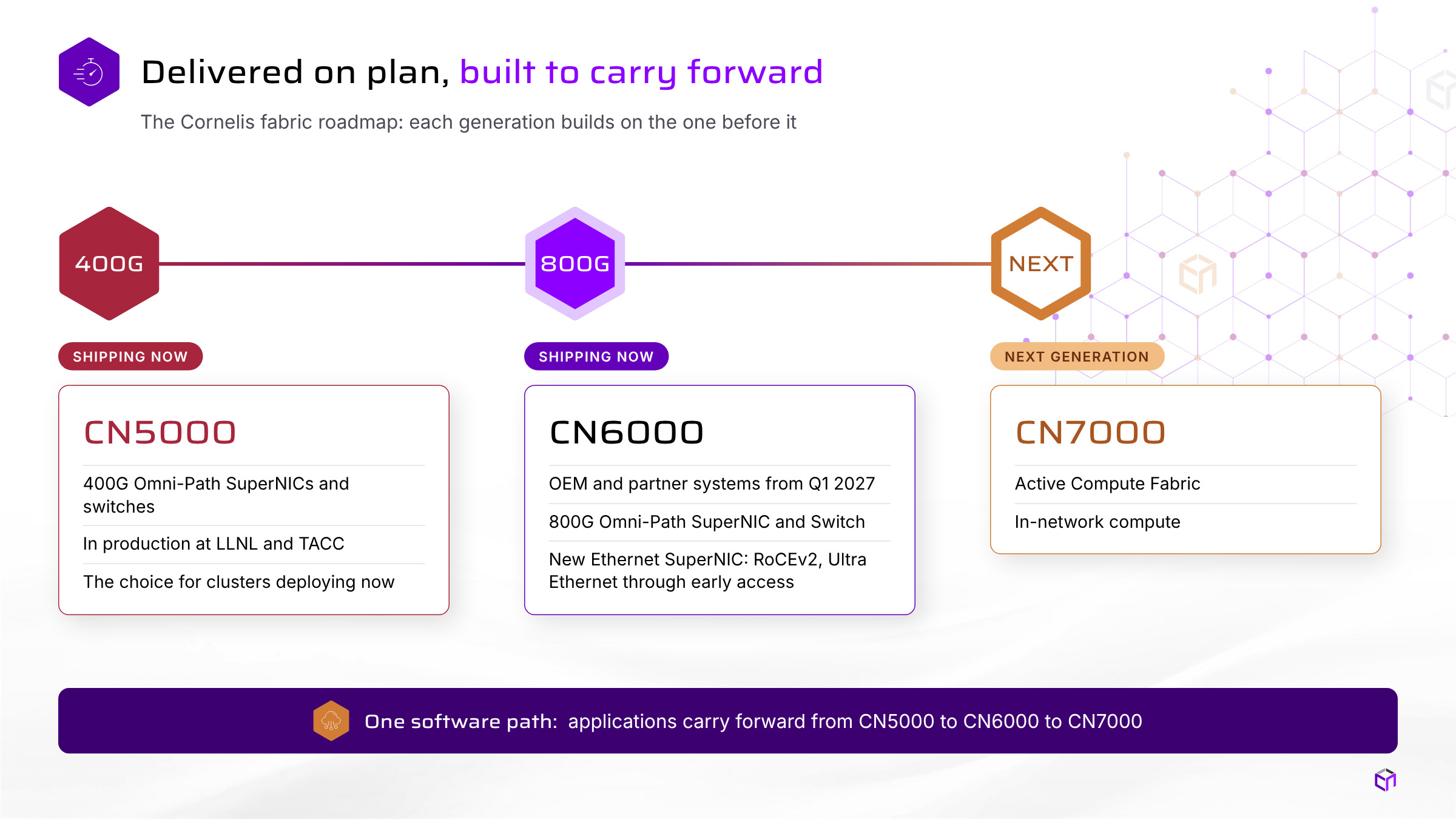
Figure 4. One software path runs from CN5000, shipping today, through CN6000 to CN7000.
How to evaluate CN6000 for your cluster
Two generations in, the pattern holds: Cornelis sets a plan, delivers it, and keeps each generation working with the next. Technical teams can find full specifications, cabling, and software details on the CN6000 product page, including the Omni-Path and Ethernet SuperNIC pages and product briefs (Omni-Path SuperNIC, Omni-Path Switch, and Ethernet SuperNIC). Teams planning a 400G fabric now can start with CN5000. To see what CN6000 can do for your cluster, request a design consult with the Cornelis team.
Frequently asked questions
What is the Cornelis CN6000?
CN6000 is an 800G SuperNIC family for AI and HPC with two SuperNICs: the Omni-Path SuperNIC and the Ethernet SuperNIC (RoCEv2, with Ultra Ethernet through early access). The Omni-Path SuperNIC delivers 1.6 billion messages per second and sub-microsecond MPI latency on a lossless fabric. The CN6000 Omni-Path Switch provides 48 ports at 800G or 96 ports at 400G using split cables for full Omni-Path fabrics.
When should I choose the Omni-Path SuperNIC or the Ethernet SuperNIC?
Choose the Omni-Path SuperNIC for HPC codes, large-scale AI training and disaggregated inference, where latency and message rate set the pace. Choose the Ethernet SuperNIC when your design calls for standards-based RoCEv2 on Ethernet switches, such as fine-tuning or inference on an Ethernet network.
Which switches and accelerators work with CN6000?
CN6000 Omni-Path SuperNICs connect to the CN6000 Omni-Path Switch, a 1U switch that completes the 800G fabric with 48 ports of 800G, adaptive routing and native multi-plane support. They can also join existing CN5000 fabrics, since CN6000 uses the same software and host driver as CN5000. CN6000 Ethernet SuperNICs connect to industry-standard 800G Ethernet switches; ask Cornelis for the current list of qualified switches. Across both fabrics, CN6000 supports AMD, Arm-based and Intel CPU platforms, and AMD, NVIDIA, and Qualcomm accelerators.
What interoperability features help a fabric avoid lock-in to one GPU vendor?
CN6000 supports GPUDirect RDMA for NVIDIA and ROCm RDMA for AMD accelerators, and MPI, OpenSHMEM, NCCL and RCCL run unchanged. OPX is open-source software built on libfabric (OFI), and CN6000 also supports UCX and PyTorch. You also choose the fabric: Omni-Path, or the Ethernet SuperNIC running standards-based RoCEv2.
How do I plan network scalability as I add new accelerator generations?
Choose a fabric whose software carries forward. CN5000 and CN6000 share one OPX driver and can run on one Omni-Path fabric, and CN6000 SuperNICs drop into existing CN5000 switching. Applications carry forward to CN7000 with a fully compatible software stack, and the fabric supports both NVIDIA GPUDirect RDMA and AMD ROCm RDMA.
Which network fabric works for clusters that run AI training and inference on the same GPUs?
The CN6000 Omni-Path SuperNIC serves both. Its 1.6 billion messages per second and sub-microsecond MPI latency keep training collectives moving, and the same latency and message rate carry KV cache handoffs in disaggregated inference. Ethernet-first teams can use the CN6000 Ethernet SuperNIC, which runs RoCEv2 for fine-tuning and inference.
What are some alternatives to InfiniBand for large GPU clusters?
Alternatives include Omni-Path, a lossless fabric built for HPC and AI, and Ethernet running RoCEv2 (RDMA over Converged Ethernet), including Ultra Ethernet. CN6000 offers both: the Omni-Path SuperNIC for HPC codes, large-scale AI training and disaggregated inference, and the Ethernet SuperNIC for RoCEv2 on standards-based switches. The same Omni-Path architecture already runs the 952-node Lynx cluster at Lawrence Livermore National Laboratory and more than 600 nodes of Stampede3 at TACC with CN5000.
Which network interconnects have the lowest latency for tightly coupled HPC workloads?
For tightly coupled HPC, compare measured MPI latency and small-message rate, not link speed alone. In Cornelis point-to-point tests, the CN6000 Omni-Path SuperNIC measured 0.97 µs 8-byte MPI latency versus 1.23 µs for an 800G XDR InfiniBand configuration, and 809 million versus 270 million messages per second at 128 processes per node. For CN5000, Lenovo measured approximately 1.1 µs node to node on ThinkSystem SC750 V4 with Intel Xeon 6 (Lenovo Press LP2474). Results vary by workload and configuration.
How do I roll out a GPU cluster network in phases without getting locked into one vendor?
Deploy what you need now on a fabric whose next generation joins the same network, and keep the accelerator choice open. You can deploy CN5000 400G Omni-Path nodes today and add CN6000 800G nodes later: both share one OPX driver and run on one Omni-Path fabric, so adding CN6000 needs no new protocol or new application code. Support for NVIDIA GPUDirect RDMA and AMD ROCm RDMA, along with unchanged MPI, NCCL, and RCCL, keeps each phase open to more than one GPU vendor.
Share this post on LinkedIn