Scaling NAMD Molecular Dynamics to 512 Nodes with Intel® Xeon® Processors and Cornelis® CN5000
Amin Shahidi, Senior Alliance Manager

Key takeaways
Scale larger molecular dynamics simulations: In the tested 512-node cluster, the NAMD STMV-28M benchmark maintained more than 90% parallel efficiency through 128 nodes and continues to scale with 69% efficiency at 512 nodes.
Sustain throughput across concurrent jobs: Sixteen simultaneous 32-node NAMD jobs achieved more than 99% of ideal aggregate throughput across the 512-node cluster.
Molecular dynamics (MD) simulations are among the most demanding High Performance Computing (HPC) workloads. They require high compute performance and fast internode communication. As HPC systems grow to hundreds of nodes, network speed becomes critical. It determines whether applications stay efficient and solve problems faster. This study tests NAMD performance on a 512-node cluster with 4th Gen Intel® Xeon® Scalable processors connected with Cornelis® CN5000 400 Gb/s fabric.
Strong-scaling benchmarks were conducted using the widely adopted STMV-8M and STMV-28M molecular systems to assess performance across a range of node counts.
Key results include:
Efficient scaling on up to 512 compute nodes, including over 90% efficiency at 128 nodes for the STMV-28M workload
Greater than 99% throughput efficiency during ensemble workload testing
Consistent performance across both time-to-solution and throughput-oriented execution models
These results show that the combination of Intel Xeon processors, the Intel MPI library, and the CN5000 fabric provides an effective platform for large-scale molecular dynamics simulations and production HPC environments.
Greater overall performance may improve when using the latest Xeon 6 processors and software.
Test environment
Benchmark testing was performed on a 512-node Intel CPU-based HPC cluster configured as follows:
Component | Configuration |
Compute Nodes | 512 |
Processor | Dual Intel Xeon Platinum 8480+ |
Cores per Node | 112 |
Memory | 512 GB DDR5 |
Operating System | RHEL 9.7 |
MPI Library | Intel MPI 2021.18 |
Application | NAMD 2.15a2 (Memory Optimized Build) |
Interconnect | Cornelis CN5000 400 Gb/s |
Fabric Software | Cornelis OPX 12.1 |
Network Topology | Fat Tree |
Test methodology
Two widely used NAMD benchmark models were selected:
STMV-8M (approximately 8 million atoms)
STMV-28M (approximately 28 million atoms)
These workloads are commonly used within the HPC industry to evaluate the scalability of NAMD.
Testing consisted of two complementary methodologies:
Strong scaling: Strong scaling evaluates how solution performance improves as additional compute nodes are added. The objective is to reduce simulation time-to-solution while maintaining high parallel efficiency.
Ensemble throughput testing: Many production HPC environments prioritize overall cluster throughput by running multiple simulations simultaneously. To evaluate throughput performance, 16 independent 32-node NAMD jobs were executed concurrently across the 512-node cluster. To test worst-case network congestion, we spread each job across the entire cluster rather than keeping it in one switch group.
Performance results
Strong scaling performance
Strong scaling measures the ability of an application to reduce time-to-solution as additional compute resources are applied to a fixed-size workload.
The larger STMV-28M benchmark establishes excellent scaling behavior, maintaining greater than 95% parallel efficiency at 32 nodes and more than 90% efficiency through 128 nodes. Even at 512 nodes, the benchmark continues to scale efficiently, achieving approximately 69% parallel efficiency.
The smaller STMV-8M workload is harder to scale because per-node work drops quickly. Even so, it retains about 65% efficiency at 512 nodes. This demonstrates the low latency and high message rate capability of the CN5000 network, two metrics that become very important when strong-scaling smaller workloads. 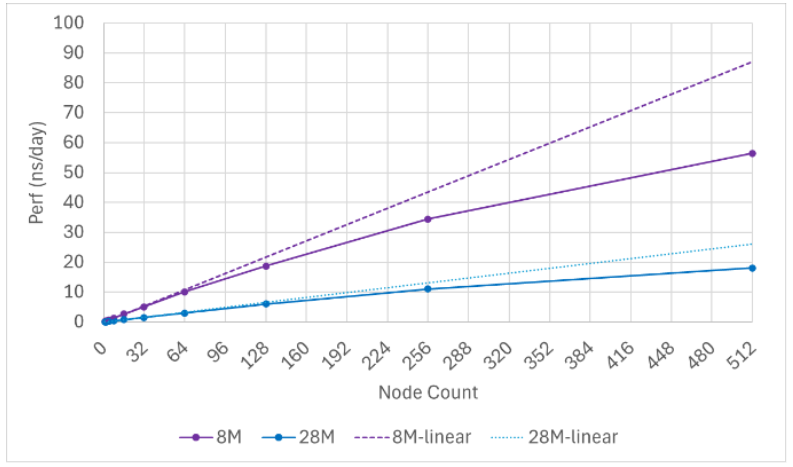
Strong scaling of NAMD STMV-8M and STMV-28M up to 512 Intel Platinum 8480+ Processor nodes with CN5000
The results show that CN5000 enables NAMD to continue delivering meaningful performance gains as cluster scale increases, reducing simulation turnaround times for large molecular dynamics workloads.
Scaling efficiency
Parallel efficiency provides insight into how effectively cluster resources are used as node counts increase. Application engineers sometimes use efficiency to pick the optimal node count to run their applications and to balance time to solution vs. cluster wall-clock budget. In other words, if twice the amount of compute nodes only provide a 50% improvement in time to solution, the additional compute nodes may not be a good use of resources.
As shown in the following figure, the STMV-28M benchmark maintains greater than 90% efficiency through 128 nodes and continues scaling efficiently to 512 nodes. The smaller STMV-8M benchmark achieves approximately 65% efficiency at 512 nodes, demonstrating the ability of CN5000 to maintain communication performance as message sizes become smaller and communication demands increase.
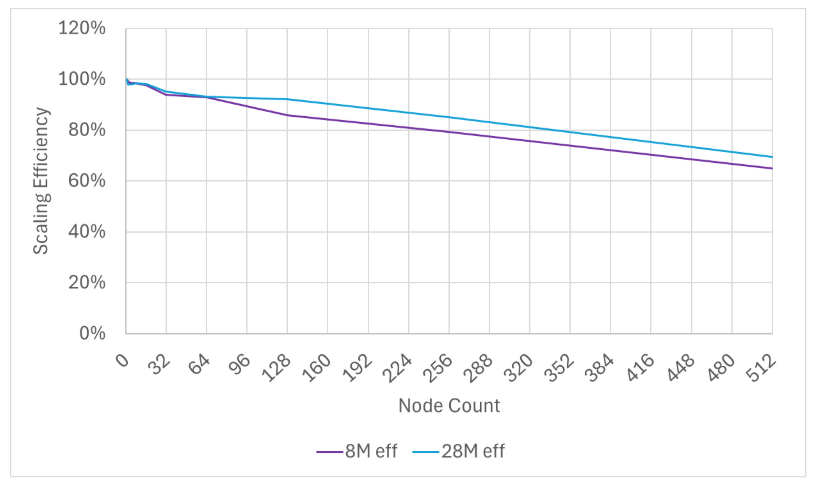
Scaling efficiency of NAMD STMV-8M and STMV-28M up to 512 Intel Platinum 8480+ Processor nodes with Cornelis CN5000
Ensemble throughput performance
While strong scaling focuses on reducing the runtime of a single simulation, many production HPC environments prioritize total cluster throughput. Many simultaneous jobs running at peak efficiency maximizes cluster utilization.
To evaluate throughput performance, 16 independent 32-node NAMD jobs were executed simultaneously across the 512-node cluster. Each job was intentionally distributed across the entire network fabric to maximize traffic and create a worst-case congestion scenario. Instead of bunching each group of 32 nodes together, the job scheduler was instructed to pick one node from each unique CN5000 Switch to increase inter-switch traffic.
Despite these demanding conditions, aggregate throughput remained greater than 99% of ideal performance relative to isolated execution.
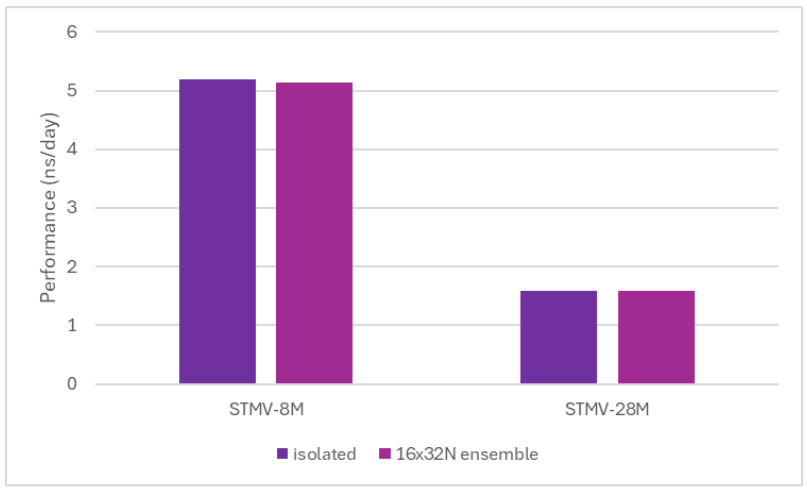
NAMD performance running an isolated 32-Node job compared to ensemble mode using 16 simultaneous 32-Node jobs
This result shows the effectiveness of CN5000’s low latency and credit-based congestion management ability. Even under heavy network utilization, application performance remained highly consistent with minimal impact from competing workloads.
These results indicate that CN5000 can effectively support multi-user production environments where cluster utilization and overall throughput are often more important than the performance of any individual job.
What the NAMD results show at scale
The results demonstrate that Cornelis CN5000 enables efficient scaling of communication-intensive molecular dynamics workloads across large HPC clusters. On a 512-node cluster with Intel Platinum 8480+ processors, NAMD reached 69% parallel efficiency at 512 nodes. It maintained over 90% efficiency through 128 nodes.
CN5000 also delivered over 99% ensemble throughput efficiency across sixteen simultaneous 32-node jobs. This test ran under worst-case congestion across the entire cluster, demonstrating the ability of the CN5000 fabric to sustain both large-scale simulation performance and high-throughput production workloads.
Combining Intel Xeon processors, the Intel MPI library, and the Cornelis CN5000 fabric delivers powerful HPC clusters. These solutions enable large scale, reduced time-to-solution workloads while keeping cluster utilization at its maximum.
CN5000 fabric in the tested cluster
Cornelis CN5000 Omni-Path® is an end-to-end high-performance networking solution engineered to deliver low-latency, high-message-rate communication for large-scale HPC and AI workloads.
At the core of the solution is the 400G CN5000 Omni-Path SuperNIC, designed to accelerate communication-intensive applications while maximizing scalability across large clusters. The CN5000 architecture combines advanced congestion management, adaptive routing, and lossless communication mechanisms to ensure predictable application performance at scale.
Key technical advantages
Lossless data transmission: CN5000 employs hardware-based credit flow control to eliminate packet loss and retransmissions, ensuring predictable performance for communication-intensive HPC applications.
Dynamic lane scaling and link-level replay: The architecture provides resiliency against cable and transceiver failures while automatically correcting transmission errors locally without impacting application performance.
Fine-grained adaptive routing: CN5000 continuously monitors fabric conditions and dynamically routes traffic around congestion points, minimizing latency variation and improving scalability for tightly coupled applications such as computational fluid dynamics.
Open standards-based architecture: Built on the OpenFabrics Alliance (OFA) Libfabric software framework, CN5000 provides vendor-neutral interoperability across modern CPU and GPU platforms without proprietary software dependencies.
These capabilities make CN5000 particularly well suited for latency-sensitive applications such as NAMD.

Figure 4. Cornelis CN5000 Omni-Path 400G portfolio
Talk to a fabric architect
The NAMD results in this article provide a reference for strong scaling and concurrent-job throughput on the tested 512-node Intel Xeon cluster with Cornelis CN5000. They cover the STMV-8M and STMV-28M workloads and the configurations described in the test environment. Use them as a starting point for your evaluation, not as a prediction for every NAMD workload or system.
If you are planning or evaluating an HPC cluster for molecular dynamics, talk with a Cornelis fabric architect. You can share your NAMD version and workload, node count, processor and MPI configuration, network topology, and whether your priority is reducing one simulation’s time-to-solution or increasing throughput across concurrent jobs. A fabric architect can help define a representative benchmark plan and identify the configuration details to capture.
We can also help you validate Xeon 6 and CN5000 performance against your specific applications.
Share this post on LinkedIn