Power Is the New Performance: Rethinking HPC Infrastructure Economics with Supermicro FlexTwin™ and Cornelis®

For decades, HPC infrastructure decisions were guided by a familiar metric: performance at all costs. Faster CPUs. Bigger clusters. Denser racks.
Today, that equation has fundamentally changed.
As HPC environments scale to support larger simulations, higher-fidelity models, and more tightly coupled workloads, power delivery, cooling efficiency, and network behavior—not raw compute—are now the primary constraints on performance and growth.
In modern HPC, power and cooling are no longer line items. They are the limiting factor.
The #1 question for HPC/AI Infra - Do you have the power?
HPC workloads are inherently sensitive to imbalance. A small inefficiency—whether in cooling, power delivery, or the network—can ripple across an entire job and materially affect time-to-solution.
Datacenter leaders are increasingly confronting challenges such as:
Rack power limits that cap system density
Cooling overhead that grows faster than compute capability
Network-induced stalls that reduce effective CPU utilization
In this environment, peak performance numbers matter far less than sustained, efficient performance at scale.
Cooling as an HPC Scaling Strategy
Supermicro's FlexTwin™ architecture reflects a critical shift in HPC system design: cooling is now a first-class design variable, not an afterthought.
In addition to CPU-only cold plate/liquid cooled FlexTwin configurations, the platform offers customers a comprehensive cold plate option that expands liquid cooling to include additional high-TDP components like the cutting edge CN5000 liquid cooled SuperNIC, achieving an impressive heat capture rate of up to 95%. This enables HPC operators to:
Increase rack density without exceeding facility power envelopes
Reduce cooling-related energy consumption per workload
Improve thermal consistency, supporting sustained CPU performance
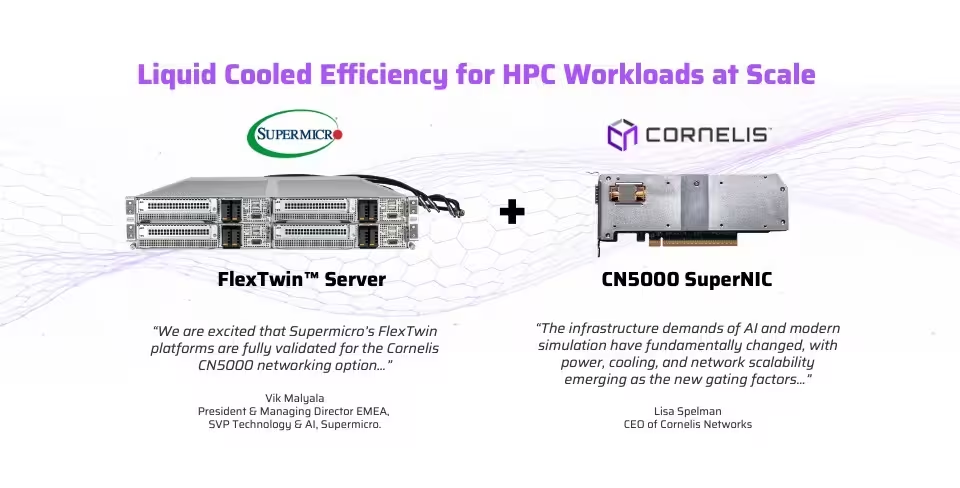
Why Power-Efficient Servers Demand a Power-Efficient Network
Cooling and server efficiency are only part of the equation.
Once compute density increases—as it does with Supermicro FlexTwin—the network becomes a critical determinant of how much useful work gets done per watt. A power-efficient server paired with an inefficient or congestion-prone network simply shifts the bottleneck, leaving CPUs stalled, jobs stretched, and energy wasted. This is where network architecture matters—not just in terms of raw throughput, but in application performance per watt.
In head to head HPC application-level benchmarks, pairing Supermicro's highly power-efficient FlexTwin server platform with the Cornelis® CN5000 400G end to end network delivered up to 2.3x higher performance per watt vs. alternate solutions which translates to either double the application performance for the same network power draw or half the network energy costs to achieve the same performance.
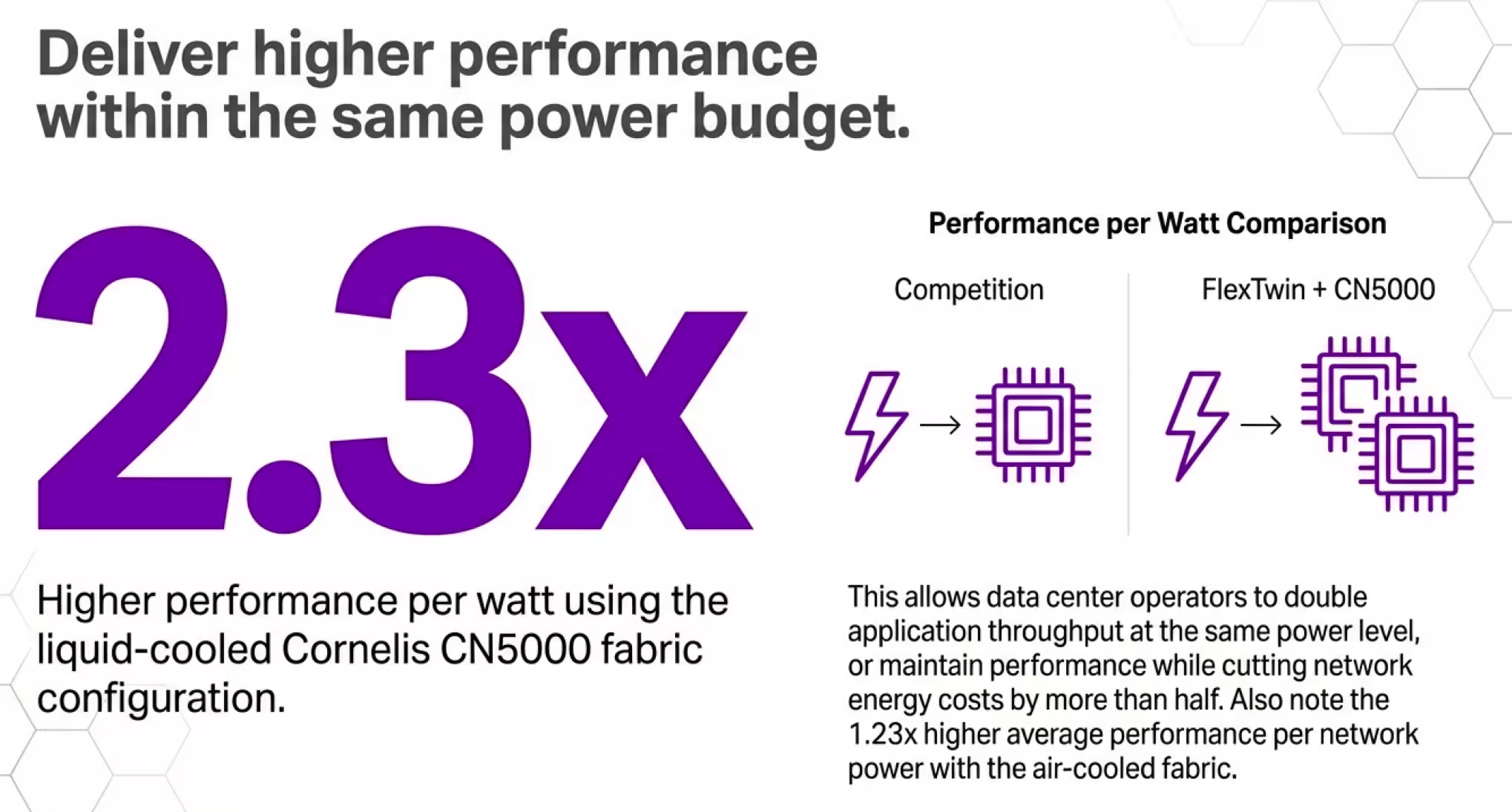
With Cornelis CN5000 HPC workloads across Manufacturing, Life Sciences and Weather/climate achieved significantly higher performance per watt as the network was able to minimize congestion, reduce retransmissions, and keep CPUs consistently fed with data—even under heavy, tightly coupled communication patterns.
The outcome is not just faster HPC—it is better HPC economics.
Learn more and connect with the HPC Networking expert at https://www.cornelis.com/contact
Share this post on LinkedIn