Agentic AI Performance: Why the Network Makes or Breaks It
Key takeaways
Improve GPU utilization: Measure communication behavior alongside task completion time, token throughput, and GPU utilization in a representative agentic workflow.
Reduce scaling risk: Test tail latency, congestion, concurrency, and failover at the intended workload and cluster scale before selecting a fabric.
Protect infrastructure investment: Compare protocol, security, compatibility, and endpoint-scale requirements against the complete CN6000 configuration.
Why your network impacts Agentic AI performance
Agentic workflows generate changing network traffic as agents call models, tools, and data services. Congestion and variable latency can leave costly GPUs waiting for data, reducing utilization and delaying results.
To understand the impact on efficiency and cost, we recommend measuring network behavior in a representative agentic workflow alongside these metrics:
Token throughput
Task completion time
GPU utilization
Agentic AI performance challenges
Unlike single-model AI solutions, agentic AI coordinates multiple agents that access different models and data sources. These agents carry out multistep workflows with minimal human involvement, communicating with other agents, systems, and data sources to achieve defined objectives. Agentic workflows can make repeated or concurrent calls to models, tools, and data services. When steps depend on earlier results, they must execute sequentially, allowing network delays to accumulate. Both average latency and tail latency can therefore affect end-to-end response time. In our conversations with a large manufacturing company, the company reported response-time delays on its existing network as it modernizes static digital twins to actively influence operations using agentic AI.
For these workflows, the network is no longer simply background infrastructure. It can enable agents to work at full speed—or become a bottleneck that limits their performance.
Four challenges for current network infrastructure
Agentic AI presents four challenges for current network infrastructure—even networks enhanced with accelerators.
Unpredictable traffic patterns
Conventional software often follows a call graph defined at design time. In agentic systems, models decide at runtime which tools to call, how often, and in what order. Similar requests can therefore produce very different traffic patterns. An ambiguous result may trigger retries, new branches, or requests for more context, making historical baselines less reliable for capacity planning and traffic engineering.
Greater sensitivity to latency
Agentic decision-making spans multiple environments, so inconsistent network latency can delay outcomes. Tail latency affects single-model inference, but agentic workflows can compound its impact across dependent calls and steps. Unpredictable traffic can introduce further delays, making consistently low latency a critical network design requirement.
More complex resilience requirements
Stalled or dropped transmissions can leave costly GPUs waiting for data. Multipath connectivity and automated failover must be managed carefully to avoid adding delays that further reduce utilization. Variable agentic traffic can also increase congestion and the risk of packet loss, particularly in networks without credit-based flow control.
Security and data sovereignty across boundaries
As data volumes grow and agent-to-agent communications cross more boundaries, security and data sovereignty become harder to manage. Protection must be built into the network fabric rather than treated as an afterthought.
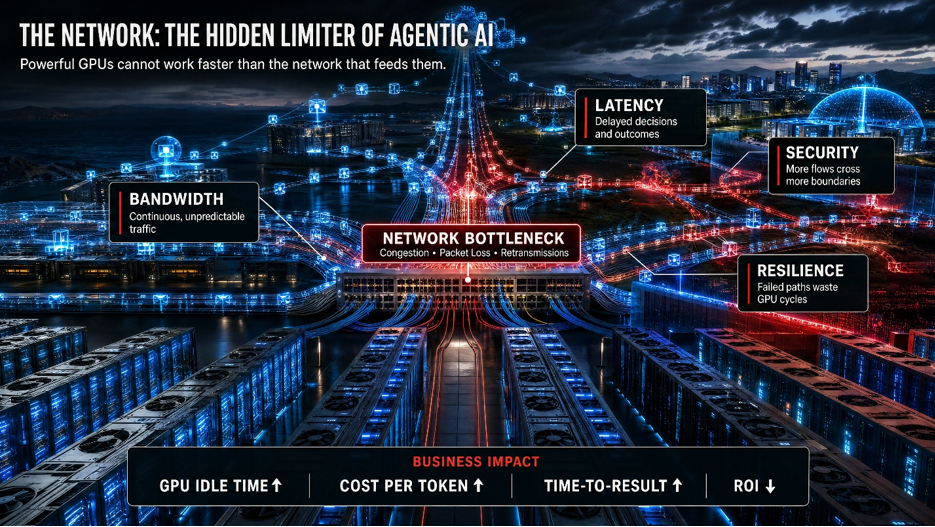
Traditional Ethernet architectures, built around packet drops and retransmission as the default congestion response, buckle under this kind of collective, machine-paced communication pressure — particularly as AI factories scale toward gigawatt-class deployments with tens or hundreds of thousands of accelerators that all need to stay synchronized.
The Cornelis Networks® approach to active, intelligent network fabrics for Agentic AI
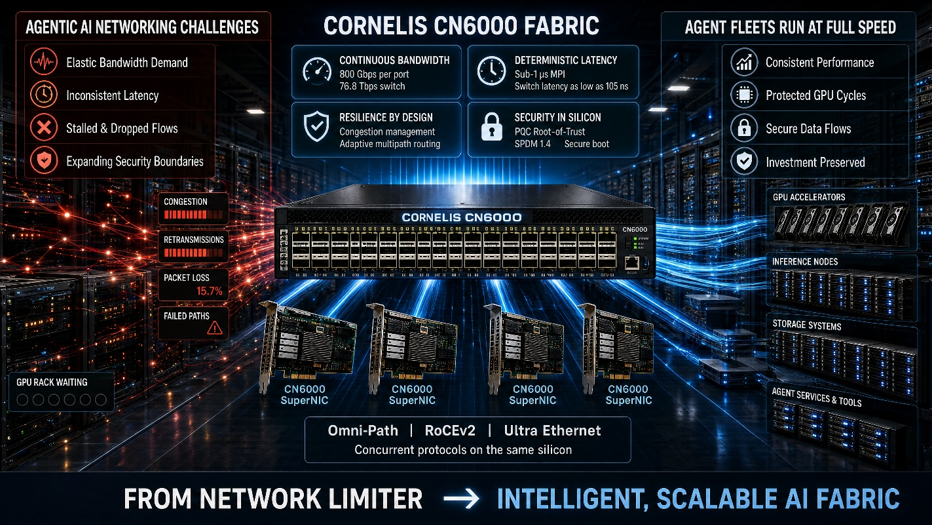
The agent-to-agent, agent-to-data, and agent-to-tool traffic described above does not originate in the WAN — it starts on the fabric connecting GPUs, storage, and inference nodes inside the AI factory. That's exactly where the Cornelis CN6000 SuperNIC and CN6000 Switch are built to remove the network as a limiter:
Continuous, scalable bandwidth: Each CN6000 SuperNIC delivers 800 Gbps (1.6 Tbps bidirectional) with an industry-leading 1.6 billion messages per second, while the CN6000 Switch packs 48 ports of 800 Gbps (76.8 Tbps full duplex)— headroom built for agent fleets that only grow busier over time.
Deterministic, business-critical performance: Credit-based flow control, Fine-Grained Adaptive Routing, and Static Dispersive Routing in CN6000 — delivering congestion-free, ultra-low latency agent communications and deterministic performance.
Resilience by design: CN6000 delivers reliable networking through fabric-wide congestion management, incast-aware flow control, and adaptive multipath routing, backed by hot-swappable, N+N redundant power and fans — protecting GPU cycles from being wasted on stalled flows.
Security engineered into the fabric: A post-quantum cryptography (PQC)-enabled Root-of-Trust with Security Protocol and Data Model (SPDM) 1.4 (ML-DSA-87 + ECDSA P-384), secure key EEPROM, and secure boot protects deployments against current and future cryptographic threats — security as a foundational design principle, not an overlay.
Each SuperNIC can be configured to one of the three protocols supported (Omni-Path, RoCEv2, or Ultra Ethernet) — connecting to existing 400/800 Gbps Ethernet switch ecosystems (Arista, Cisco, Juniper, NVIDIA Spectrum) without a forklift upgrade and preserving investment through backward compatibility with CN5000 infrastructure.
Planning advice for Agentic AI network infrastructure
For agentic AI, network performance is defined by consistency at scale, not peak throughput. Ask whether the fabric can maintain low tail latency as agent fleets expand from thousands to hundreds of thousands of nodes, rather than only delivering impressive latency under light loads. Look for platforms that support multiple protocols simultaneously, eliminating the tradeoff between HPC-level performance and existing Ethernet investments. Favor architectures with security built into the silicon, including hardware roots of trust and post-quantum cryptography, instead of bolted-on safeguards. And when planning capacity, evaluate port density and endpoint scalability based on where your AI deployments will be in two to three years, not where they happen to be today.
How to get started
Start with one representative agentic workflow and measure task completion time, tail latency, communication time, token throughput, GPU utilization, and behavior under concurrency. Then compare the complete configuration, including the SuperNIC, switch, topology, software stack, protocol configuration, and workload placement. You can then use the results to decide whether to tune your current system, change the fabric, or add capacity.
Review the CN6000 SuperNIC product brief and the CN6000 Switch product brief. Then contact Cornelis Networks to scope an evaluation using your workloads and target business metrics.
Share this post on LinkedIn